The Fake Dealership Scam: How One Buyer Lost $22,000—and How to Bulletproof Your Remote Purchase
· News
The Fake Dealership Scam: How One Buyer Lost $22,000—and How to Bulletproof Your Remote Purchase
Finding the perfect vehicle online can feel like a major victory. The price is right, the photos look great, and it's exactly the model you've been searching for. But for one buyer in Wisconsin, that victory turned into a $22,000 nightmare that serves as a critical warning for anyone buying a car remotely.
A Hartford man found what he thought was a great deal on a 2017 Chevy Silverado from a Texas dealership called "JDM Auto Sales." He secured a loan from his local credit union, which then wired the full $22,000 directly to the seller. The moment the money was sent, the dealership vanished. Their website went offline, their phone number was disconnected, and the address turned out to be fake.
The buyer was left with no truck, no money, and a car loan he is still required to pay back.
This devastating scenario isn't a freak accident; it's a calculated scam—often referred to in the industry as "cloning" or "ghost cars"—and it is becoming increasingly common in the digital marketplace. At Inspectd, we see the aftermath of these fraudulent operations all too often. Here’s a breakdown of how this scam works and the exact steps you can take to ensure you are transacting with total confidence.
Anatomy of the Scam: How It Works
Scammers rely on a predictable playbook that preys on a remote buyer's excitement and distance. They create a convincing illusion of a legitimate business to lure you into a vulnerable position.
The Lure: Scammers post listings for popular vehicles at prices that are significantly below market value. This "too good to be true" price is designed to attract immediate attention and create a sense of urgency.
The Professional Facade: They build a clean, professional-looking website complete with stolen photos (often scraped from real dealership lots), a company name, and a phone number. They may even list a physical address, which is often a vacant lot or an unrelated business discovered through Google Maps.
The Controlled Communication: The "seller" will be highly responsive and helpful, but only through text and email. They will consistently deflect requests for a live video call with excuses for why they can't accommodate you. This prevents you from seeing that they don't actually possess the car.
The Push for a Wire Transfer: This is the critical step. The scammer will insist on a bank wire transfer for payment. They know that wire transfers are fast, irreversible, and difficult to trace.
The Disappearing Act: As soon as the wire transfer is confirmed, the scammer cuts off all contact. The website, email address, and phone number are all burned, leaving the buyer with no vehicle and no way to recover their funds.
Red Flags: Warning Signs of a Fake Dealership
Protecting yourself starts with knowing what to look for. Distance is no longer an excuse to skip your due diligence. Be extremely cautious if you encounter any of these red flags:
Below-Market Pricing: A price that is thousands of dollars below Kelley Blue Book or local market data is the number one warning sign.
Refusal of a Live Video Call: A legitimate seller with the vehicle in their possession will have no problem doing a live video walkaround. Excuses are a major red flag.
High-Pressure Tactics: Scammers will often claim other buyers are waiting with cash to rush you into sending a wire before you can verify their claims.
Wire Transfer is the Only Option: Legitimate dealerships and private sellers offer multiple, traceable payment options. An insistence on a wire transfer from an unknown seller is a classic trap.
Vague or Unverifiable Address: Always use Google Maps Street View to check the seller's listed address. If it’s an empty field, a residential home, or a completely different business, walk away.
Your Shield: A 4-Step Verification Playbook
Knowledge is your first line of defense, but physical verification is your ultimate protection. Follow this simple playbook for every remote vehicle purchase.
1. Verify the Seller, Not Just the Car Before you fall in love with the vehicle, investigate the seller. Search the dealership's name online for independent reviews, check with the Better Business Bureau, and confirm their business license with the state. A real dealership leaves a verifiable footprint.
2. Demand Visual, Real-Time Proof Treat the online listing as a brochure, not a guarantee. Ask for a live video call where the seller walks around the car, shows you the VIN plate on the dash, and starts the engine. Ask them to show you the current odometer reading and a copy of the title (with a matching VIN). If they refuse, end the conversation.
3. Never Pay with an Unverified Wire Transfer Treat a wire transfer like handing a stranger a bag of cash across state lines. It offers zero buyer protection. If you must pay remotely, use a secure third-party escrow service, or better yet, do not fund the loan until the asset is verified.
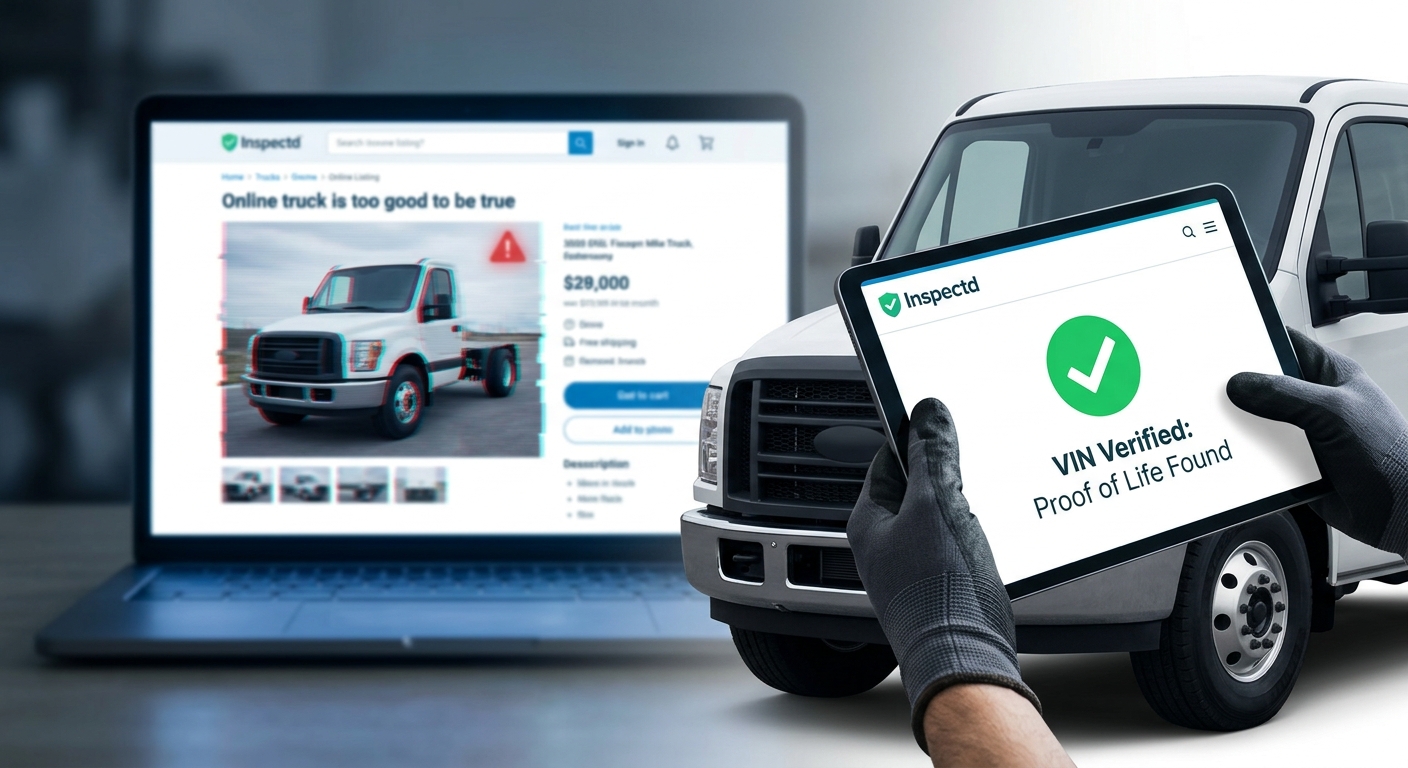
4. Get Independent Eyes on the Ground (The "Proof of Life") The single most effective way to completely neutralize this scam is to have an independent, trusted professional physically stand next to the vehicle before you send a single dollar.
This is exactly why we built the Inspectd Supernetwork. Distance is no longer a barrier. By ordering a VINsight™ Pre-Purchase Inspection, our managed verification process provides you with the ultimate ground-truth data:
Proof of Life: We dispatch an independent, certified professional directly to the seller's location. If the dealership doesn't exist or the car isn't there, we find out before your money leaves your bank account.
Identity Verification: We physically verify the VIN on the vehicle and cross-reference it with the paperwork to ensure you aren't buying a cloned or stolen asset.
Condition Reality: Beyond fraud prevention, our Prism AI™ and standardized reporting protocols give you a comprehensive digital condition report on the mechanical, structural, and cosmetic health of the vehicle. Facts, not feelings.
An on-site verification removes all doubt. It confirms you are dealing with a real seller and a real car, stopping digital scammers in their tracks. Don't trust a seller's word; trust independent, physical verification.
Don't become the next headline. Before you commit to an out-of-state vehicle purchase, commit to the truth. [Order your VINsight™ Inspection today.]